
I’ve only been sitting opposite Aisling Bea for a few minutes and I’m already laughing. We’re sat in a 1970s boss man type’s study in a grand townhouse where the Anthropologie shoot is taking place. She’s sat stroking my dog, who has taken up residence on her feet and I’m just tittering pathetically.
Aisling Bea is funny. Funny in a way that no matter how serious the subject matter, it’s delivered loaded with witty banter and physical comedy. People who love Ireland: “paddyphiles”. Diversity in her homeland: “Ireland is populated by white people and ghosts”. Her friend, the writer Dawn O’Porter says, “Aisling is a continuous stream of effortless high-end comedy. She’s a one-woman joke generator.”
It’s a few days after This Way Up, the Channel 4 series she wrote and starred in, aired in the UK and she is about to leave for New York to promote it in the US. The show is a smash. To illustrate this she’s telling me she missed her hip-hop dance class because she’s been spending so much time, liking and favouriting all the social media feedback. “I don’t want people to feel unseen.”
Now 35, Aisling Bea is good at her job. She can do all kinds of funny, from sketch shows like Cardinal Burns, to edgy stand up (try her Netflix special), and crowd-pleasing sitcoms, like Trollied and Dead Boss. She’s is a stalwart of those brutally gladiatorial male dominated panel shows. Early next year she’s in the British Rom Com, Love, Wedding, Repeat and next month [October] she co-stars with Paul Rudd in a new international Netflix comedy, Living With Yourself about a man who clones himself in order to become a better person. Bea has to be one of the most well-rounded female comedians working today. What This Way Up shows is that the girl can write too.
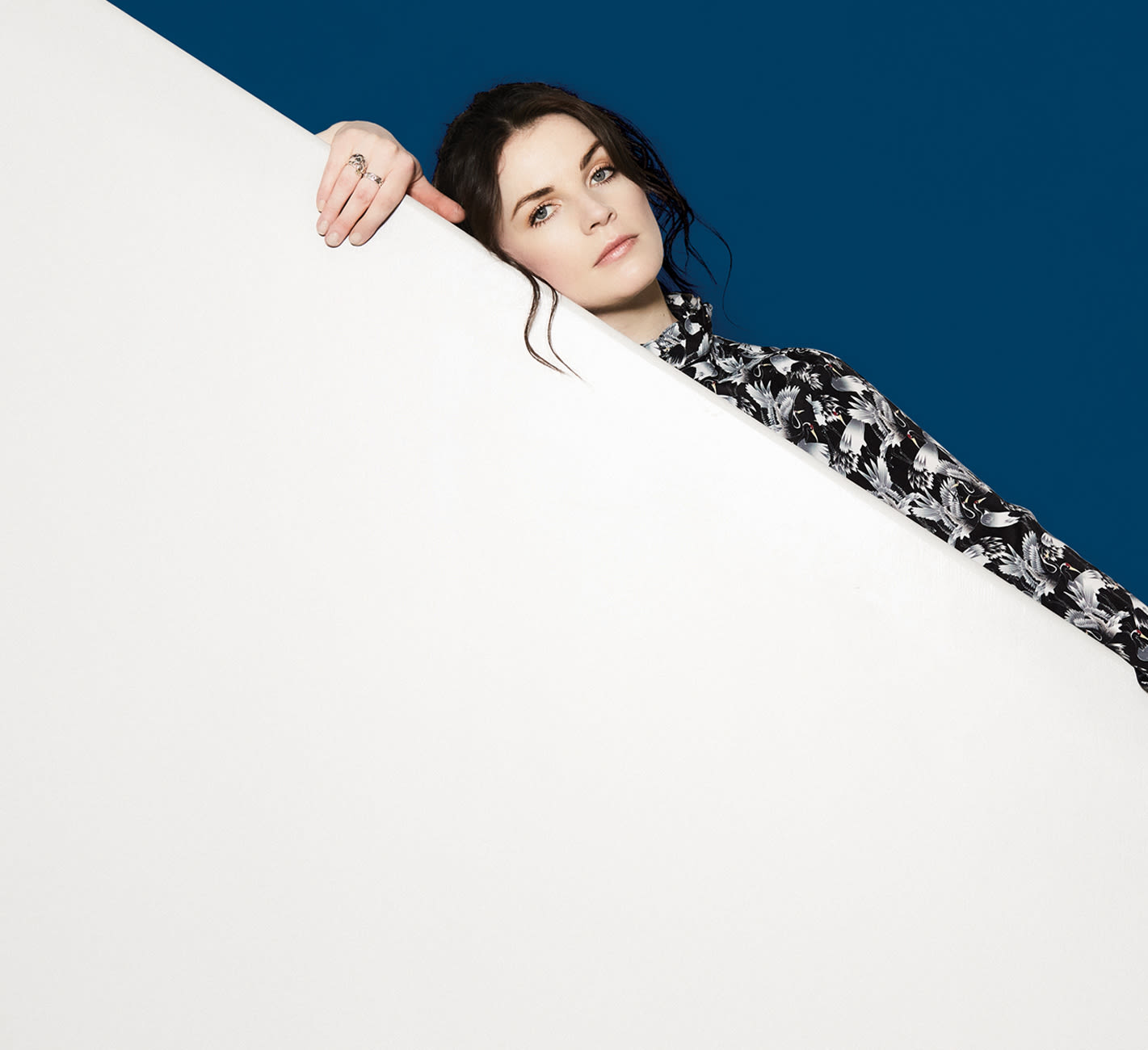

Funny Business:
Meet Aisling Bea
Words by Kate Spicer | Photography by Chris Floyd
She has inevitably been compared to actress and writer Phoebe Waller-Bridge. Like Fleabag, This Way Up has a cast of deeply flawed characters, not least its central one, Aine, played by Bea, who is recovering from a nervous breakdown and a stint in rehab. Despite its eminent watchability, pace and humour, the series does not swerve tragedy – mental illness, loneliness, suicide, masculinity in crisis racism and alcoholism to name a few. It is a real joy to watch. I gobbled it up in one sitting.
Proud of her “passion project,” she says that, “In the run up to the show I allowed myself to think people were going to really like it, instead of thinking, some will but loads will hate it.”
Years in development, originally This Way Up was a show about the relationship between sisters. “I could write that stuff for days. Sharon [Horgan, who co-stars as Aine’s sister, Shona] and I have a very sisterly relationship and I wrote the show for her.” Then two years ago, Bea wrote a piece in The Guardian about the great tragedy of her own life, her father’s suicide when she was three. In it she managed to mention suicide and the Spice Girls in the same sentence and get away with it. “After the article about my Dad, which I don’t regret by the way, a lot of people got in touch. The show is my fictional response to them.
“You can see in the feedback to This Way Up the things that people really connected with: moving somewhere and being lonely is a big one. That, and funny people breaking down. People are going, ‘that’s me’. Given the different types of people getting in touch, I feel like I did my job there.”
As a writer and a performer she “smuggles”, as The Guardian described it, the politics, convictions and opinions that matter to her. Her big thing is that even in the midst of great pain, people tend not to stop being funny, so dealing with difficult subject matter does not necessarily mean the end of the laughs. There’s a scene in This Way Up where her character Aine, in a state of hyperwokeness, assumes she is witness to the aftermath of a racist crime where there is, in fact, just a domestic pratfall. Why did she feel the need to do this?
Proud of her “passion project,” she says that, “In the run up to the show I allowed myself to think people were going to really like it, instead of thinking, some will but loads will hate it.”
Years in development, originally This Way Up was a show about the relationship between sisters. “I could write that stuff for days. Sharon [Horgan, who co-stars as Aine’s sister, Shona] and I have a very sisterly relationship and I wrote the show for her.” Then two years ago, Bea wrote a piece in The Guardian about the great tragedy of her own life, her father’s suicide when she was three. In it she managed to mention suicide and the Spice Girls in the same sentence and get away with it. “After the article about my Dad, which I don’t regret by the way, a lot of people got in touch. The show is my fictional response to them.
“You can see in the feedback to This Way Up the things that people really connected with: moving somewhere and being lonely is a big one. That, and funny people breaking down. People are going, ‘that’s me’. Given the different types of people getting in touch, I feel like I did my job there.”
As a writer and a performer she “smuggles”, as The Guardian described it, the politics, convictions and opinions that matter to her. Her big thing is that even in the midst of great pain, people tend not to stop being funny, so dealing with difficult subject matter does not necessarily mean the end of the laughs. There’s a scene in This Way Up where her character Aine, in a state of hyperwokeness, assumes she is witness to the aftermath of a racist crime where there is, in fact, just a domestic pratfall. Why did she feel the need to do this?
“I realised that there but for the grace of God go I. So many people get into a state where they project their holier than thou beliefs on things. Anyone who doubles down and goes, ‘No I am definitely right’. No human can possibly be right all the time and to think that way lies great idiocy. We can all be idiots. It hurts when you feel you’re a lefty liberal trying to do the right thing and someone goes, ‘Sorry, you’re a dick’. You need to be able to admit when you’ve got it wrong and listen rather than doubling down.”
Born Aisling Cliodhnadh O’Sullivan in County Kildare, Bea comes from a literary family of writers and poets. Her second language is a toss-up between the Irish language, Gaelic, and French, which she studied with philosophy at Trinity Dublin, the beautiful and highly regarded university in Ireland.
She tells me a story about her French oral exam. “I was good at acting French – doing all the shoulder shrugging. The examiner asked, ‘what do you think of the smoking ban?’ and I just forgot the French for smoking, fumée.” Aisling performs a little sketch for me right there and then based on her miming a long conversation about smoking, “I mean, we all know French is mostly sign language, don’t we?”
I ask her what kind of degree she got and that turns into a spontaneous sketch too, which ends with Aisling standing up to accept her degree. “I wasn’t partying at university – I spent four years doing plays and comedy sketch shows; it was like having a full time job. The truth is, I knew French and Philosophy weren’t the thing. The thing on the side was the thing.”
Born Aisling Cliodhnadh O’Sullivan in County Kildare, Bea comes from a literary family of writers and poets. Her second language is a toss-up between the Irish language, Gaelic, and French, which she studied with philosophy at Trinity Dublin, the beautiful and highly regarded university in Ireland.
She tells me a story about her French oral exam. “I was good at acting French – doing all the shoulder shrugging. The examiner asked, ‘what do you think of the smoking ban?’ and I just forgot the French for smoking, fumée.” Aisling performs a little sketch for me right there and then based on her miming a long conversation about smoking, “I mean, we all know French is mostly sign language, don’t we?”
I ask her what kind of degree she got and that turns into a spontaneous sketch too, which ends with Aisling standing up to accept her degree. “I wasn’t partying at university – I spent four years doing plays and comedy sketch shows; it was like having a full time job. The truth is, I knew French and Philosophy weren’t the thing. The thing on the side was the thing.”
Behind the gags and laughter, there is a hardworking and very clever woman. Gaelic is, as Aisling describes: “A beautiful language, I’m so lucky to have it. It’s my secret sister language, I use it with my sister, Sinéad, and my best friend, Brona [C Titley, the comedy writer] as a language of intimacy.” She also speaks Gaelic with Horgan. “If a large group of men came in I’d forget that I can’t lean in to you and start talking to you in Irish.”
For a moment I wish some builders would come in and that I spoke Gaelic; it would be pretty cool to be in her gang. Later on, I mention intersectional feminism briefly, forgetting she is part of an elite band of women rewriting the feminist narrative one joke at a time and, for them, repartee about intersectional feminism is normal. Akin to a Love Island WhatsApp group that can count Lena Dunham, Deborah “Guilty Feminist” Frances-White and Scarlett Curtis as its participants.
Her next big project to air is Living With Yourself, which raises the question of who would we be if we could be the best version of ourselves. I wonder, given her ascending star and exciting pals, whether she has ever had to check herself for being a bit ‘showbiz’. “Oh no, I went the other way”, she says. “I was so anxious about my success, I would always flag up negative things that were happening and go over the top apologising: ‘I’m earning now, I’m so sorry about that. I’m doing well now, I’m so sorry about that. So sorry I’m on the telly.’ I wasn’t a dick.”
We move on to the costume design on This Way Up, which includes a well-worn sheepskin jacket that Aine wears every time she leaves the house. I say how much I love the realness to the looks. Aine’s style is bonkers in a way that is in equal parts bad and kind of cool. This Way Up’s costume designer is Sinéad Kadio, Bea’s younger sister. "She is so good, I definitely couldn’t have got her if she wasn’t my sister – she just came off Greta Gerwig’s new Little Women and is working on the new Steve McQueen project.”
“That jacket, there’s a story to it. It was a present from my Dad to my mother on their one-year anniversary and I can’t ever throw it away but Sinead has determined that I can’t wear it out the house anymore.”
The pride is audible as she describes the Costume Directory, her sister’s non-profit collaboration with BAFTA. “It’s about making the costume world more sustainable. A quarter of our budget was spent in charity shops and every costume featured at least one second-hand item. We also sourced from sustainable and ethical brands, and emerging designers.” This isn’t done only in sustainability’s name, “I can’t tell you how much I love rooting through charity shops. People say, ‘Aisling, you’ve got money now, why are you shopping in Sue Ryder?’”
We talk about something else for a while. And then she backtracks to our previous conversation. “I cannot let you write down that I am not a dick because that would be lies. Of course I’m a dick sometimes. Humans are not angels or devils. We can all be dicks sometimes, while mostly striving to be a good person.”
For a moment I wish some builders would come in and that I spoke Gaelic; it would be pretty cool to be in her gang. Later on, I mention intersectional feminism briefly, forgetting she is part of an elite band of women rewriting the feminist narrative one joke at a time and, for them, repartee about intersectional feminism is normal. Akin to a Love Island WhatsApp group that can count Lena Dunham, Deborah “Guilty Feminist” Frances-White and Scarlett Curtis as its participants.
Her next big project to air is Living With Yourself, which raises the question of who would we be if we could be the best version of ourselves. I wonder, given her ascending star and exciting pals, whether she has ever had to check herself for being a bit ‘showbiz’. “Oh no, I went the other way”, she says. “I was so anxious about my success, I would always flag up negative things that were happening and go over the top apologising: ‘I’m earning now, I’m so sorry about that. I’m doing well now, I’m so sorry about that. So sorry I’m on the telly.’ I wasn’t a dick.”
We move on to the costume design on This Way Up, which includes a well-worn sheepskin jacket that Aine wears every time she leaves the house. I say how much I love the realness to the looks. Aine’s style is bonkers in a way that is in equal parts bad and kind of cool. This Way Up’s costume designer is Sinéad Kadio, Bea’s younger sister. "She is so good, I definitely couldn’t have got her if she wasn’t my sister – she just came off Greta Gerwig’s new Little Women and is working on the new Steve McQueen project.”
“That jacket, there’s a story to it. It was a present from my Dad to my mother on their one-year anniversary and I can’t ever throw it away but Sinead has determined that I can’t wear it out the house anymore.”
The pride is audible as she describes the Costume Directory, her sister’s non-profit collaboration with BAFTA. “It’s about making the costume world more sustainable. A quarter of our budget was spent in charity shops and every costume featured at least one second-hand item. We also sourced from sustainable and ethical brands, and emerging designers.” This isn’t done only in sustainability’s name, “I can’t tell you how much I love rooting through charity shops. People say, ‘Aisling, you’ve got money now, why are you shopping in Sue Ryder?’”
We talk about something else for a while. And then she backtracks to our previous conversation. “I cannot let you write down that I am not a dick because that would be lies. Of course I’m a dick sometimes. Humans are not angels or devils. We can all be dicks sometimes, while mostly striving to be a good person.”